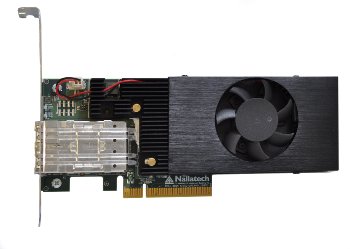
I was looking around for FPGA based PCIe boards when I came across something interesting from Nallatech. They’ve created two OpenCL compatible PCIe boards designed especially for the finance market. Named rather creatively “Nallatech 385” and “Nallatech 395”, they’re both based on the Stratix V from Altera which is the best of Altera’s high-end FPGAs. Both boards have a PCIe Gen3 x 8 lane host interface that should allow you to transfer data between the FPGA and the host machine at about 7.88 gigabytes per second (985MB/s per lane x 8). For connection to the market, the boards have SFP+ cages into which you can plug modules for 1Gb Ethernet, 10Gb Ethernet, SONET/SDH & OTN. The main differences between the boards seems to be the amount and speed of the on-board memory and the number of network interfaces.
[Read More]Nallatech Releases FPGA Boards for High Frequency Trading
I was looking around for FPGA based PCIe boards when I came across something interesting from Nallatech. They’ve created two OpenCL compatible PCIe boards designed especially for the finance market. Named rather creatively “Nallatech 385” and “Nallatech 395”, they’re both based on the Stratix V from Altera which is the best of Altera’s high-end FPGAs. Both boards have a PCIe Gen3 x 8 lane host interface that should allow you to transfer data between the FPGA and the host machine at about 7.88 gigabytes per second (985MB/s per lane x 8). For connection to the market, the boards have SFP+ cages into which you can plug modules for 1Gb Ethernet, 10Gb Ethernet, SONET/SDH & OTN. The main differences between the boards seems to be the amount and speed of the on-board memory and the number of network interfaces.
[Read More]FPGAs in High Frequency Trading
Back in 2009 I did a presentation on why companies needed to be using FPGAs in their high frequency trading:
Why You Need FPGA In Your High-Frequency Trading Business
View more presentations from jeffjohnsonau
Now every man and his dog are trading with FPGAs and the edge is now blunt as a spoon. But rather than a time to walk away it’s time to change tactics. Here’s what you should be doing now:
[Read More]JP Morgan applies FPGA to risk management
You might already know I’m interested in the application of FPGAs in the financial markets, a field that has been growing over the last few years. JP Morgan has been working on this over the last 3 years and its paying off.
JP Morgan supercomputer offers risk analysis in near real-time
Prior to the implementation, JP Morgan would take eight hours to do a complete risk run, and an hour to run a present value, on its entire book. If anything went wrong with the analysis, there was no time to re-run it.
[Read More]